

Announcing the 2026 Society Award Recipients!
Society For Biomaterials Announces its 2026 Award Recipients
SFB’s prestigious industry awards recognize outstanding achievement and
contributions to the biomaterials field.
February 24, 2026, Mt. Laurel, NJ — The Society For Biomaterials (SFB), a multidisciplinary society of academic, healthcare, governmental and business professionals who are dedicated to promoting advancements in all aspects of biomaterials science, education, and professional standards to enhance human health and quality of life, recently announced its slate of 2026 award recipients.
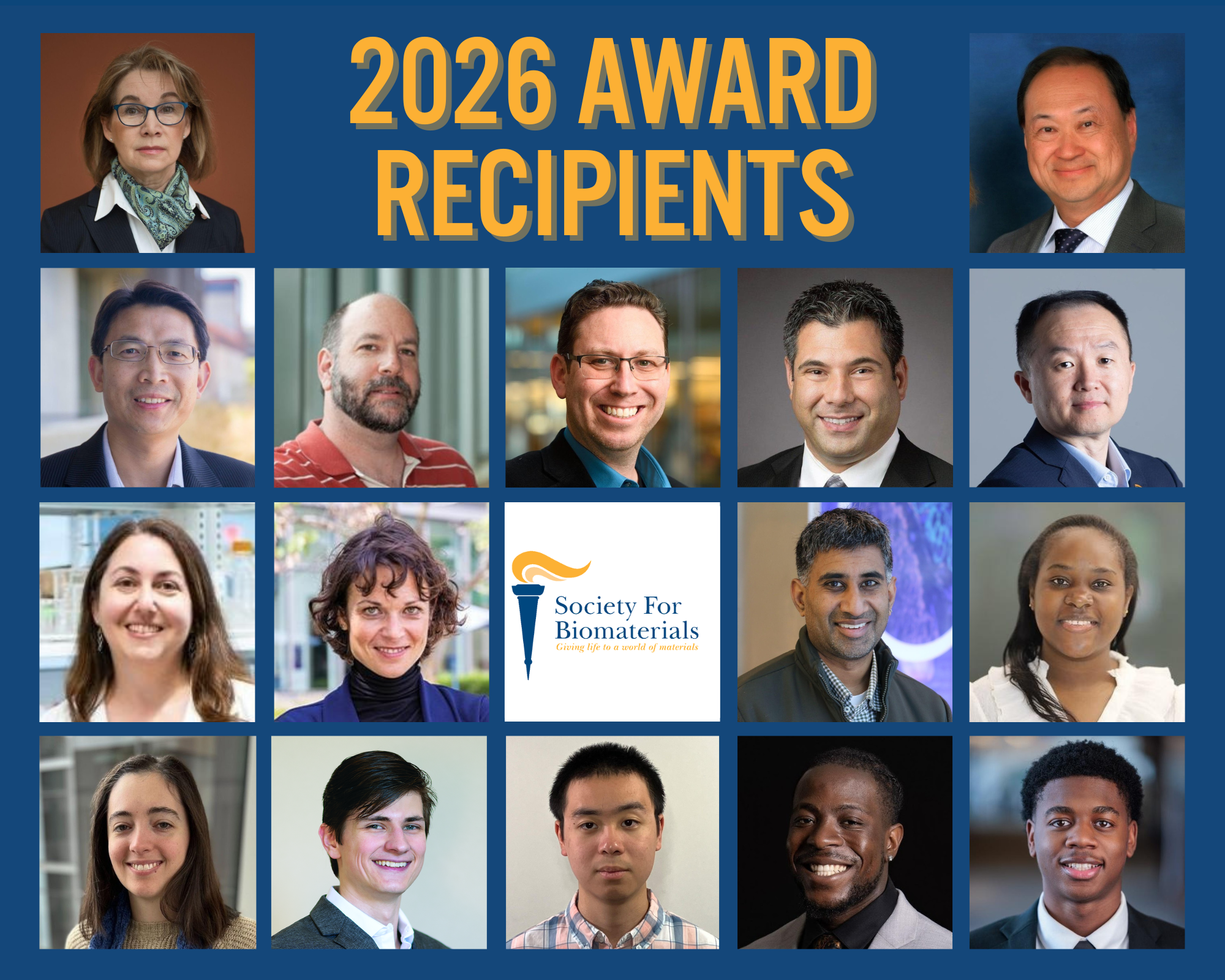
The Society For Biomaterials is Proud to Present their 2026 Award Winners:
FOUNDERS AWARD:
Martine LaBerge, PhD, Clemson University
This award honors an individual who has made a long-term, landmark contribution to the biomaterials discipline.
“Dr. LaBerge has been a member of SFB and its community for over 40 years. She is internationally recognized for pioneering contributions to orthopaedic tribology and for advancing our understanding of lubrication and wear mechanisms in both natural and artificial joints. Her laboratory was among the first to characterize the phospholipid profile of articular cartilage boundary lubricant, and her group developed key models for wear mechanisms in total joint replacement, which has influenced implant design and improved patient outcomes. Beyond orthopaedics, her contributions to endovascular tribology have also informed device design and clinical practice.”
—Delphine Dean, PhD, Clemson University
C. WILLIAM HALL AWARD:
Vincent Ling, PhD, Morphocell Technologies
This award honors an industry and government member of the Society For Biomaterials
who has made a significant contribution to the Society and has an outstanding record in establishing, developing, maintaining and promoting the objectives and goals of SFB.
“Dr. Ling’s extensive background, experience in scientific and business development, unique ability to transform laboratory innovations into commercially viable platforms, and substantial contributions to SFB make him a highly qualified candidate for the Society for Biomaterials' C. William Hall Award. His sustained impact on healthcare innovation, from regenerative medicine to biologics and drug delivery, exemplifies the purpose of this award and promises to inspire others in the field. I wholeheartedly recommend him for this award and am confident that his recognition would honor his remarkable contributions to our field.”
—Ankur Singh, PhD, Georgia Institute of Technology
SOCIETY FOR BIOMATERIALS AWARD FOR SERVICE:
David Kohn, PhD, University of Michigan
This award honors significant service to the Society For Biomaterials in establishing, developing, maintaining and promoting its objectives and goals.
“Throughout his distinguished career, Dr. Kohn has contributed meaningfully to every dimension of the Society For Biomaterials' mission. His leadership, commitment, and unwavering dedication have helped shape the trajectory of the Society and the broader biomaterials community. From mentoring the next generation of scientists and engineers to spearheading initiatives that strengthen our professional standards, his impact has been both deep and wide-ranging. He has been actively involved in the Dental Biomaterials SIG, serving as SIG Chair (1996-1999); and has organized numerous symposia (1997- 1999, 2002, 2006). He has been an advocate for community building: serving on the Educational and Professional Development Committee and serving as the University of Michigan Student Chapter Advisors. Dr. Kohn has also played a major role in the leadership of the SFB serving as President, President-Elect, Secretary-Treasurer and as a member of the Long-Range Planning Committee, Task Forces, SFB Board, and SFB Council.”
—Lynne Jones, PhD, Johns Hopkins University School of Medicine
TECHNOLOGY INNOVATION AND DEVELOPMENT AWARD:
Shaochen Chen, PhD, University of California San Diego
This award recognizes an individual’s (or a team’s) successful application of basic and applied biomaterials research in the development of a novel medical product or technology that significantly benefits the health and well-being of medical and surgical patients.
“Dr. Chen has transformed the field of biomaterials through innovations in microscale and nanoscale 3D printing. His early work established hydrogel-based microscale printing platforms (Adv. Drug Deliv. Rev., 2004; J. Biomed. Mater. Res., 2005) and projection-based printing methods (2006), enabling rapid, precise fabrication of biomaterials with superior integrity. He then invented Dynamic Optical Projection Stereolithography (DOPsL, Adv. Mater., 2012), a breakthrough that allows continuous 3D bioprinting at speeds 1,000 times faster and with 100-fold higher resolution than extrusion-based methods. This technology eliminated interlayer defects and was later patented and licensed to CELLINK.”
—Kam W. Leong, PhD, Columbia University
CLEMSON AWARD FOR APPLIED RESEARCH:
Jordan Green, PhD, Johns Hopkins University
This award recognizes an individual whose accomplishments include significant utilization or application of basic knowledge in science to achieve a specific goal in the field of biomaterials.
“Dr. Green has built an interdisciplinary lab that is well known for innovation in biomaterials and drug delivery, especially for polymeric nanoparticles for gene delivery. In parallel, he has patented technology at MIT and at JHU, 134 publications, written 9 book chapters, and 86 patents and pending patents. He started AsclepiX Therapeutics and currently serves as the CTO of AsclepiX Therapeutics, which specializes in delivery of novel antiangiogenic peptides. He has been awarded numerous awards including being elected Fellow to the Biomedical Society 2019, Fellow Controlled Release Society 2021, Fellow National Academy of Inventors 2021.”
— Robert Langer, PhD, Massachusetts Institute of Technology
CLEMSON AWARD FOR BASIC RESEARCH:
Omid Veiseh, PhD, Rice University
This award recognizes an individual who has made an original contribution to the basic knowledge and understanding of the interaction between materials and tissue.
“Dr. Veiseh’s lab has pioneered innovative approaches to synthesizing and screening large libraries of biomaterial formulations for tailored applications in immunology and medicine. He is recognized for his seminal work in discovering immunomodulatory biomaterials that can interact appropriately with the host immune system for use in the development of chronic implants. These technologies have successfully been deployed for applications in drug delivery, regenerative medicine, and continuous disease monitoring. Over the course of his career, he has authored and co-authored more than 80 peer-reviewed publications, including those in Nature, Nature Biotechnology, Nature Materials, Nature Medicine, and Nature Biomedical Engineering, and is an inventor on more than 80 pending or awarded patents.”
— Robert Langer, PhD, Massachusetts Institute of Technology
CLEMSON AWARD FOR CONTRIBUTIONS TO THE LITERATURE:
Jian Yang, PhD, Westlake University
This award recognizes an individual who has made a significant contribution to the literature on the science or technology of biomaterials.
“Most notable is Dr. Yang’s pioneering work on citrate-based polymers as metabolism-regulating biomaterials and photoluminescent and photoacoustic citrate-containing polymers for imaging, diagnostics, and tissue stimulation. The former was the basis for his leadership in establishing new research directions for the design and fabrication of scaffolds for tissue and regenerative engineering applications – metabonegenesis, which spawned research in citrate biology for bone regeneration and became the basis for the growing area of bioenergetic biomaterials, and metabotissuegenesis, which emphasizes the metabolic role of citrate for the regeneration of all tissues (Adv Sci 2019, Adv Mater 2024). Without a doubt, Dr. Yang is the leading scientist for the field of metabolism-regulating biomaterials for tissue engineering, regenerative engineering, and regenerative medicine applications.”
—Guillermo Ameer, ScD, Northwestern University
MID-CAREER AWARD:
Katelyn E. Swindle-Reilly, PhD, Ohio State University
This award recognizes an individual SFB member who has demonstrated outstanding achievements in and / or contributions to the field of biomaterials research at the mid-career stage.
“Dr. Swindle-Reilly has secured funding from the NIH, DOD, Ohio Lions Foundation, and state-level translational initiatives. Her recent work on ocular drug delivery and rheology of the vitreous humor has generated > 100 citations. However, her most significant scholarly contributions are in the patent literature. She has > 70 issued or pending patents. Her innovations resulted in the founding of Vitranu, a start-up at which she serves as the Chief Technical Officers. Vitranu is commercializing her ocular drug delivery technologies, including a tunable release capsule for age-related macular degeneration. This breakthrough addresses the burden of frequent intraocular injections, enhancing patient compliance.”
—Jessica O. Winter, PhD, Ohio State University
YOUNG INVESTIGATOR AWARD:
Claudia Loebel, MD, PhD, University of Pennsylvania
This award recognizes an individual who has demonstrated outstanding achievements in the field of biomaterials research at the early career stage.
“Claudia is a brilliant and innovative scientist that has accomplished much during her training and in her independent faculty position. I firmly believe that the work that Claudia’s group is doing will push our understanding of mechanobiology and mechanosensing within the field of fibrosis and tissue injury. She has received a number of grants and awards such as the highly competitive David and Lucile Packard Foundation Fellowship, which is only given to a small group of researchers each year across all disciplines, the Macromolecular Rapid communications Junior Researcher Award, the Cell and Molecular Bioengineering Rising Star Award, and the Cell and Molecular Bioengineering young Innovator Award. Other grants include the NIH R35 MIRA Award, the American Lung Association Innovation Award, and the Biological Sciences Scholarship Program. Claudia has also been dedicated to the advancement of SFB for many years – I think it would be hard to find a young faculty member that has contributed more to the society at this stage. As a postdoctoral fellow, Claudia was Vice Chair (2020/2021) and then Chair (2021/2022) of the SFB Young Scientist Group and was co-chair of the SFB Mental Health Workshop. She is also a Founder of the Biomaterials Postdoctoral Recognition Award program, which she has now chaired from 2020-2026. As a young faculty member, she has already become an Associate Editor for the society journal Journal of Biomedical Materials Research A. More recently, she has been the Chair of the SFB Symposium at MS&T in Columbus Ohio in 2023 and is Program Chair of the BioInterfaces Special Interest Group (2024/2025).”
—Jason Burdick, PhD, University of Colorado
OUTSTANDING RESEARCH BY A HOSPITAL INTERN, RESIDENT OR CLINICAL FELLOW AWARD:
Rameshwar Rao, Seattle Children's Research Institute
This award recognizes a Hospital intern, resident, clinical fellow, medical student, or an individual in an equivalent position who has demonstrated outstanding achievement in biomaterials research.
“When Dr. Rao joined my lab early in his fellowship, his objective was to merge his clinical focus on pediatric solid tumors with biomaterials research. His work was funded by the highly competitive national Pediatric Scientist Development Program (PSDP), an NIH K12 that selects seven Pediatric fellows nationally. He designed a study that defined the impact of the extracellular matrix on osteosarcoma chemoresistance. Dr. Rao’s clinical insight led him to develop a metronomic treatment regimen combining regorafenib, a tyrosine kinase inhibitor used in metastatic and relapsed osteosarcoma patients, with standard chemotherapy to overcome cell-matrix-induced chemoresistance. This work has been widely recognized, earning the Society for Pediatric Research Fellow’s Basic Science Award (2023), the Connective Tissue Oncology Society Best Poster Award (2023), and the prestigious Society for Pediatric Research David G. Nathan Award for Basic Research (2024), which is awarded to one Pediatric fellow nationally.”
— Sarah Heilshorn, PhD, Stanford University
STUDENT AWARD FOR OUTSTANDING RESEARCH | PhD CATEGORY:
Thalma Orado, Texas A&M University
This award recognizes a PhD student who has shown outstanding achievement in biomaterials research.
“Thalma Orado coordinated our group’s collaborations with two other labs (Xiaocun Lu at Clarkson University and Pranav Soman at SU) to ensure successful completion of the work. Her exciting and promising results will ultimately result in wound dressings with easy-to-use infection surveillance capabilities. In the manuscript’s acceptance letter, JBMRA’s editor, Dr. Kent Leach, wrote “Congratulations on this interesting study. I enjoyed reading it!” I have published in JBMRA multiple times, and this was the first time that I received a personalized note from the editor about the work upon acceptance. Thalma’s current research is building on this technology to enhance the sensitivity and specificity of these materials towards pathogenic bacteria. I anticipate that her second, 1st author manuscript will be submitted this fall and she will complete 1-2 additional manuscripts before defending her dissertation next summer. These are in addition to her 4 co-authored manuscripts (two from her former lab and two from my lab).”
—Mary Beth Browning Monroe, PhD, Texas A&M University
STUDENT AWARD FOR OUTSTANDING RESEARCH | PhD CATEGORY:
Katherine Meinhold, University of Washington
This award recognizes a PhD student who has shown outstanding achievement in biomaterials research.
“Katherine Meinhold uses her biomaterials training and materials science knowledge to the benefit of multiple collaborators here at UW and beyond. She is actively working on 3 collaborative projects ranging from using her fibers to support human iPSC differentiation to osteoblasts with a drug of interest for long bone repair, to establish an in vitro model of anisotropy necessary for human iPSC derived cardiomyocyte pulsing behavior to probe a question about a key myosin-supporting protein, and as a substrate for beta zeolite incorporation to be used for PFAS adsorption and quantification.”
—Jenny Robinson, PhD, University of Washington
STUDENT AWARD FOR OUTSTANDING RESEARCH | Undergraduate CATEGORY:
Aiden Walter, Rose Hulman Institute of Technology
This award recognizes an undergraduate student who has shown outstanding achievement in biomaterials research.
“Aiden Walter is truly remarkable. He is a fast learner and quickly became independent in the lab. I would often walk into the lab throughout the summer, and Aiden was always busy doing an experiment in the lab on his own. The work that will be presented in the manuscript is largely what he accomplished over the summer – which is truly amazing for an undergraduate. Aiden’s mentor described him as “curious, committed, and organized” and that he was highly engaged in the research. Towards the end of the summer, Aiden presented to our research group. He presented one of the best, if not the best, presentations I have ever seen from an undergraduate researcher in my lab – I have mentored nearly 90 undergraduates over my 20 years. He articulated the motivation of his research and research hypothesis clearly, he demonstrated that he had developed a strong fundamental understanding of his project and did an excellent job answering questions. He went on to present his poster to the department and received 2nd place. In addition, he also received the Albert Einstein Award, which is given to one student who demonstrated strong leadership, integrity and solid laboratory skills. This award exemplifies what I saw in Aiden during his time in my lab.”
—Stephanie Bryant, PhD, University of Colorado
C. WILLIAM HALL – UNDERGRADUATE TRAVEL SCHOLARSHIP:
Zhiyuan Chen, Purdue University
This award honors the memory of the Society's first president, Dr. C. William Hall. This student scholarship is awarded to a junior or senior undergraduate pursuing a bachelor's degree in bioengineering or a related discipline.
“As a research advisor, I have had several highly driven undergraduate students who have contributed to publications. It is a very elite group of intelligent, technically proficient, and creative students to be part of. In my view, Jerry (Zhiyuan) not only belongs in this elite group, but also raises its bar in terms of academic achievement and professional accomplishments. ”
—Taimoor Qazi, PhD, Purdue University
CATO T. LAURENCIN, MD, PHD - UNDERGRADUATE TRAVEL FELLOWSHIP:
Isaiah Williams, University of Connecticut
Joshua Wilkins, North Carolina A&T State University
Named in honor of a distinguished member of the Society For Biomaterials, Cato T. Laurencin, MD, PhD, the travel fellowship will support undergraduate students from underrepresented minorities in the field of biomaterials to attend the 2026 Annual Meeting & Exposition.
“Isaiah worked closely with my Masters student to learn the challenging technique of 3D printing silicone. 3D printing of elastomers doesn’t always go according to plans, but he persisted and successfully produced test squares in order to evaluate the compressive strength, the heat transfer and moisture transfer of the materials.”
—Liisa Kuhn, PhD, University of Connecticut Health Center
“Currently, Joshua is conducting an exciting research project focused on the fabrication and characterization of curcumin-loaded polycaprolactone (PCL) nanofibers for biomedical applications. This work represents an important contribution to the field of biomaterials, combining innovation in drug delivery systems with practical applications in wound healing and inflammation management.”
—Narayan Bhattarai, PhD, North Carolina A&T State University
About the Society For Biomaterials:
The Society for Biomaterials is a professional society that promotes advances in biomedical materials research and development by encouragement of cooperative educational programs, clinical applications, and professional standards in the biomaterials field. Biomaterials scientists and engineers study cells, their components, complex tissues and organs and their interactions with natural and synthetic materials and implanted prosthetic devices, as well as develop and characterize the materials used to measure, restore, and improve physiologic function, and enhance survival and quality of life. One of the defining aspects of SFB is its commitment to bridging the gap between academic research and its application within an industry setting to advance the biomaterials field and lead to innovations in research, patient care and policy.
For more information, please visit: biomaterials.org.